I have enjoyed reading some of the 2009 JavaOne presentations since they have been made available online. One of the presentations I was most interested to read was Joseph Darcy's Small Language Changes in JDK Release 7: Project Coin (TS-4060). I have blogged on Project Coin previously, but am using this blog post to summarize some of the things I found most interesting about this JavaOne presentation.
Improved Dynamic Language Support on the JVM
Scripting languages on the JVM have begun to really gain traction in terms of popularity and use. One of Darcy's first slides mentions JSR 292 ("Supporting Dynamically Typed Languages on the Java Platform"), which proposes a new bytecode called invokedynamic and additional support for easier implementation of dynamic languages on the Java Virtual Machine.
Improved Modularity
The presentation also has a slide focusing on the desired improved modularity expected for Java SE 7. This was a popular topic at 2009 JavaOne as evidenced by the presentations on it (such as the one on Project Jigsaw) and by the Mark Reinhold quote "The classpath is dead." This actually is a very significant change, but it is briefly covered in this presentation.
The Elvis Operator
One of the "small features" covered in this presentation is the so-called "Elvis operator," a more concise version of the ternary operator. I find myself missing some of the features of Groovy when using traditional Java and this would be one operator that I could use in both languages if it was added. The "Elvis" operator is handy for specifying a default value that can be used when the evaluated expression is null. Like Groovy's safe navigation operator, it is a concise way to specify how to avoid unnecessary nulls. I have blogged previously about how I like to avoid the NullPointerException.
Switch on String in Java
Joe Darcy is a submitter of the proposal to add the ability to switch on String in Java. I have blogged previously regarding this versus the ability to switch on String in ActionScript. Although I find myself missing the ability to switch on a String in Java less now with the fantastic Enum and polymorphism, there are still situations I run into (often when using third-party libraries) where it would be nice to switch on a String.
Better Exception Handling
A slide in this presentation covers the proposed improvements to exception handling to allow a single catch statement to catch multiple explicitly specified exceptions. This can be much nicer than repeating code in each individual exception catch block.
Other Small Language Features Being Considered
There are a few other potential new Java SE 7 language features covered in the slides of this presentation. They include automatic resource management, type inference ("Diamond"), and list and map literals.
On Selecting What To Include
Although it is interesting to see which small language change proposals are being seriously considered, perhaps the most interesting aspect of this presentation for me is the coverage of the many things that must be considered when weighing which options to add. Darcy talks in this presentation about the importance of thinking in the big perspective rather than with limited view of what would be nice. He has a slide titled "Greed is Not Always Good" and includes perhaps the most important point to keep in mind when thinking about what one would like in Java:
"Default response is to keep the language as-is. Burden is on the proposer to convince that a change gets in; burden is not to convince to keep a change out."
I also enjoyed Darcy's slides covering all the work involved in a language change above and beyond the implementation of the feature itself. He has an overview slide in which he demonstrates the many related artifacts that must be updated such as the Java Language Specification and updating the Javadoc output. Darcy devotes several slides to each of the artifacts that need updating and then really drives the point home by using the introduction of the enum as an example. I love the enum, but it is obvious that it needed to be really desired to justify the effort.
What's Not Going to be in Java SE 7
After making a compelling case for adequately comparing the value and benefit of a particular new language feature to the cost of its introduction, Darcy has a slide in which he highlights in red some popular new features that will NOT be going into Java SE 7. These are contrasted on the same slide with features first implemented in J2SE 5. What interests me about this slide is to see where features punted from Java SE 7 (closures, reification [my favorite], and properties) rank in terms of effort against features that were implemented with J2SE 5 (enums, autoboxing/unboxing, annotation types, and generics).
Keeping Up with Project Coin and Other Java SE 7 Developments
Because Java SE 7 is still clearly a work in progress, it is not surprising that one slide in the presentation warns about forward-looking statements in the presentation. We should all be aware that any of these mentioned changes may not actually end up in Java SE 7. I have found Alex Miller's Java 7 site to be my favorite one-stop shop for the latest news on Java SE 7 developments. He apparently scours the web and blogosphere for articles that he links there and writes his own blog postings and articles as well. He currently has the status of inclusion of many proposed features listed on his page ("YES" for still planned for Java SE 7, "NO" for explicitly punted from Java SE 7, or other status if not known for certain).
Other useful sources of information include Joseph D. Darcy's Weblog, the Project Coin web page, Danny Coward's Weblog, Mark Reinhold's Blog, Neal Gafter's Blog, and Stephen Colebourne's Weblog.
Thứ Tư, 1 tháng 7, 2009

Thứ Hai, 29 tháng 6, 2009
Writing Code Is Much Like Writing Prose
There are many similarities when comparing the writing of code to the writing of prose. Because of this, we should be able to learn from doing each of these and apply things learned from one to the other.
The Absolutes
In writing code and in writing prose, there are a few things that are either absolute or approach very nearly the status of absolute. This is especially true for programming languages where syntactic and semantic rules must be followed for the code to be compiled and/or interpreted correctly. Even when a programming language supports certain generally frowned-upon features, some of these features are avoided to such a large degree that they almost appear absolute. For example, direct use of "goto" is generally frowned upon and is rarely seen in most code bases. However, less obvious versions of this (such as
Although it is less strictly enforced in writing prose, there still is significant pressure to conform to certain absolutes even in writing prose. For example, it is generally assumed that most professional prose will include sentences that begin with capital letters and end with periods. Similarly, proper names are almost always capitalized and correct spelling and reasonable grammar are also expected. The degree of enforcement for such things in prose often depends on the media. Professional papers and articles typically are the most enforced with the author and professional editors investing significant effort into polishing the prose. On the opposite end of the spectrum are e-mail messages, blogs, and Twitter messages, which seem to have less enforced absolutes.
The Frowned-Upon
Although there are a small number of absolutes or near-absolutes as just discussed, code development and prose writing seem to have many more things that are not absolutely avoided but seem to be strongly discouraged. However, these things tend to creep in despite their negative reputations because they do offer some advantages. Usually the advantages these items offer are ease for the writer at the expense of later reader or maintainer having more difficult prose or code.
Many developers realize problems associated with using so-called "magic numbers." However, they still seem to crop up. Often they are put in place "temporarily" and then forgotten or limited schedules prevent replacing them with a constant. These "magic numbers" are quick and easy to use when doing initial development, but can lead to a maintenance nightmare. Global variables offer a similar trade-off of easy early development at the expense of maintainability, robustness, and scalability.
Prose authoring has similar frowned-upon, but still often used, features. For example, it is often said that sentences should not end with prepositions. Similarly, it is often said that strong, active voice should be used. The tense of the writing should also be consistent. These are all things that are recommended because they do offer recognized benefits, but they are also easy to ignore or cheat on a bit when it is not deemed worth the time or effort to satisfy all of them all of the time.
The Standards
Since nearly the beginning of software development, developers have seemed to want to create and adhere to coding standards and conventions. Of course, we also seem to have been resistant to other peoples’ ideas of standards and conventions for nearly as long. The reason most of us are willing to give up some "creative freedom" and adhere to standards and conventions is that we have learned that code is more readable and maintainable (especially by others) when we adhere to a minimum set of conventions.
Prose can benefit from the same benefits of standardization and convention. There are books such as Elements of Style and Chicago Manual of Style devoted to prose style. Most of the arguments in favor of these prose writing style conventions are the same arguments used in favor of coding conventions: easier to read and maintain and consistency to benefit different readers and authors/developers.
One style issue is very similar between prose writing and code development. The subject of spaces can be surprisingly controversial in both arenas. In software development, most developers seem to agree that the optimal number of spaces for indentation is between 2 and 4 spaces. However, trying to narrow down which of these is best (2 spaces or 3 spaces or 4 spaces) is significantly more difficult.
There has been a controversy in the prose writing world regarding how many spaces should follow a period that ends one sentence before the first letter of the next sentence. I grew up thinking that two spaces was the expected number of spaces between the end of one sentence and the beginning of the next sentence. However, I was recently informed by a prose reviewer and editor that a single space is now preferred. I wondered if this was a web browser-inspired shift, but there seems to be evidence that this shift started even before the widespread adoption of HTML.
Conciseness
There seem to be differences of opinion on whether prose should be concise or verbose. To some extent, this depends on the subject of the prose. I prefer technical prose to be as concise as possible while still remaining thorough. This is especially true of technical references. However, with novels, extra verbosity can sometimes be nice to explain the story and character development. This can even go too far, for my taste, as evidenced by Moby Dick.
I have found that even in software development there is a wide diversity of opinion about conciseness of code. The longer I work in the industry, the more I value conciseness. However, I know many Java developers who don’t like the same degree of conciseness that I like. An example of this is the Java ternary operator. This operator has really grown on me, but I still know many Java developers who do not care for it at all. Although many developers are migrating to programming languages that emphasize and value conciseness, there are limits to how concise we want to be. After all, none of us are probably too excited to write and maintain production code that can be sneakily squeezed into a single line.
Refactoring
"Refactoring" is a popular term in software development, but it does have its equivalent in prose writing. In my case, I find that when I revisit my own articles, I continually "refactor" the text to make it flow better, to reduce unnecessary repetition, and to make it generally more concise. The editors of formal articles often do this to an even greater degree. In fact, the editors’ reviews often remind me of how developers are eager to change others’ peoples’ code to match their own preferences. Some of the "refactorings" I see in both development and in article editing have marginal value. However, I think most of us can agree that some "refactoring" or editing is useful and recommended for writing code or for writing prose.
When the editors and reviewers at Oracle Technology Network recommended cutting my original draft of the Basic JPA Best Practices article to less than half its original draft size, it took some effort to "refactor" that article to that point. Although some minor details and some explanatory text were removed in the process, most of the substance was retained even though the final article had half as many words as my original draft. It was not trivial trimming that draft down without losing too much substantial content, but the effort the reviewers, editors and I invested is reflected in the improvements. That article still weighs in around 11 pages, but it is leaner, tighter, and more optimized than my original draft. That sounds awfully similar to the benefits of code refactoring. The process really was like refactoring because it was more than just removing words; it involved changing words and changing sentence structure and paragraph structure.
I don’t spend much time reviewing my blog posts at the time of their writing. I think this is common among blogs, though some are exceptions. Because of this, most of us expect blog posts to be rougher than formal articles. There are definitely different expectations for different forms of writing. Similarly in code, prototypes and demonstration code can often be a little "rougher around the edges" than highly reviewed and refactored production code.
More Knowledge Means More Expressiveness
When writing prose, one of the most useful techniques for writing concise but thorough prose is to know and carefully use the appropriate words and phrases. Words have different nuances and these nuances can be used to provide more expressiveness with the same number of words. In code, we see the same thing. There is often more than one way to get the job done, but thorough understanding of the language’s features and provided class libraries allows us to select the most appropriate language feature or class that provides the exact nuanced solution appropriate to the problem at hand.
When writing prose, it is common to use well-known idioms and phrases to imply much more than the few words would normally imply. For example, "a picture is worth a thousand words" consists of only seven words but implies much more than what we might say with only seven words. Some assumed knowledge is required (readers must be familiar with the idiom) to make this work. In code, we often use design patterns and other common phrases to succinctly describe much larger ideas that otherwise would require much more description.
The Value of Review
I have found that both code and prose that I write benefit when reviewed by someone else. When I write my own code or prose, I know what I am trying to say and it all makes sense. Reviewers of articles and reviewers of code can ask questions about what is intended and provide feedback that makes the code or article more generally appealing. Sometimes we’re too close to the product for our own good and the reviewer can help us to see things that we don’t see.
"Readable" is in the Eye of the Beholder
To some degree, what is "readable" depends on the person doing the reading. This applies to both prose and code. Readers (whether reading prose or someone’s code) have their own preferences. Just as we all like different prose authors’ writing, it is not surprising that we each find different styles of code easier or more difficult to read. For example, I have an easier time reading code written by people who have similar tastes and preferences to mine. For this reason, I don’t think we’ll ever see a single programming language or framework that everyone uses. There is just too wide of a spectrum of differences of opinion for any one language or framework to appeal to everyone. This is also an important observation to realize when writing code or prose. You can try to appeal to the widest set possible, but no matter what you do there will probably be at least a small group of people who don’t like it.
Conclusion
Writing prose and writing code have much in common. Many of the same techniques that make better prose also make better code. In both cases, knowing what one has to work with (vocabulary and common phrases for prose and language features and class libraries for code) can make it easier to write particular effective prose or code. Both types of writing also benefit tremendously from review. Many of the same controversies surround both types of writing.
The Absolutes
In writing code and in writing prose, there are a few things that are either absolute or approach very nearly the status of absolute. This is especially true for programming languages where syntactic and semantic rules must be followed for the code to be compiled and/or interpreted correctly. Even when a programming language supports certain generally frowned-upon features, some of these features are avoided to such a large degree that they almost appear absolute. For example, direct use of "goto" is generally frowned upon and is rarely seen in most code bases. However, less obvious versions of this (such as
break and continue in Java) do seem to be less strictly avoided.Although it is less strictly enforced in writing prose, there still is significant pressure to conform to certain absolutes even in writing prose. For example, it is generally assumed that most professional prose will include sentences that begin with capital letters and end with periods. Similarly, proper names are almost always capitalized and correct spelling and reasonable grammar are also expected. The degree of enforcement for such things in prose often depends on the media. Professional papers and articles typically are the most enforced with the author and professional editors investing significant effort into polishing the prose. On the opposite end of the spectrum are e-mail messages, blogs, and Twitter messages, which seem to have less enforced absolutes.
The Frowned-Upon
Although there are a small number of absolutes or near-absolutes as just discussed, code development and prose writing seem to have many more things that are not absolutely avoided but seem to be strongly discouraged. However, these things tend to creep in despite their negative reputations because they do offer some advantages. Usually the advantages these items offer are ease for the writer at the expense of later reader or maintainer having more difficult prose or code.
Many developers realize problems associated with using so-called "magic numbers." However, they still seem to crop up. Often they are put in place "temporarily" and then forgotten or limited schedules prevent replacing them with a constant. These "magic numbers" are quick and easy to use when doing initial development, but can lead to a maintenance nightmare. Global variables offer a similar trade-off of easy early development at the expense of maintainability, robustness, and scalability.
Prose authoring has similar frowned-upon, but still often used, features. For example, it is often said that sentences should not end with prepositions. Similarly, it is often said that strong, active voice should be used. The tense of the writing should also be consistent. These are all things that are recommended because they do offer recognized benefits, but they are also easy to ignore or cheat on a bit when it is not deemed worth the time or effort to satisfy all of them all of the time.
The Standards
Since nearly the beginning of software development, developers have seemed to want to create and adhere to coding standards and conventions. Of course, we also seem to have been resistant to other peoples’ ideas of standards and conventions for nearly as long. The reason most of us are willing to give up some "creative freedom" and adhere to standards and conventions is that we have learned that code is more readable and maintainable (especially by others) when we adhere to a minimum set of conventions.
Prose can benefit from the same benefits of standardization and convention. There are books such as Elements of Style and Chicago Manual of Style devoted to prose style. Most of the arguments in favor of these prose writing style conventions are the same arguments used in favor of coding conventions: easier to read and maintain and consistency to benefit different readers and authors/developers.
One style issue is very similar between prose writing and code development. The subject of spaces can be surprisingly controversial in both arenas. In software development, most developers seem to agree that the optimal number of spaces for indentation is between 2 and 4 spaces. However, trying to narrow down which of these is best (2 spaces or 3 spaces or 4 spaces) is significantly more difficult.
There has been a controversy in the prose writing world regarding how many spaces should follow a period that ends one sentence before the first letter of the next sentence. I grew up thinking that two spaces was the expected number of spaces between the end of one sentence and the beginning of the next sentence. However, I was recently informed by a prose reviewer and editor that a single space is now preferred. I wondered if this was a web browser-inspired shift, but there seems to be evidence that this shift started even before the widespread adoption of HTML.
Conciseness
There seem to be differences of opinion on whether prose should be concise or verbose. To some extent, this depends on the subject of the prose. I prefer technical prose to be as concise as possible while still remaining thorough. This is especially true of technical references. However, with novels, extra verbosity can sometimes be nice to explain the story and character development. This can even go too far, for my taste, as evidenced by Moby Dick.
I have found that even in software development there is a wide diversity of opinion about conciseness of code. The longer I work in the industry, the more I value conciseness. However, I know many Java developers who don’t like the same degree of conciseness that I like. An example of this is the Java ternary operator. This operator has really grown on me, but I still know many Java developers who do not care for it at all. Although many developers are migrating to programming languages that emphasize and value conciseness, there are limits to how concise we want to be. After all, none of us are probably too excited to write and maintain production code that can be sneakily squeezed into a single line.
Refactoring
"Refactoring" is a popular term in software development, but it does have its equivalent in prose writing. In my case, I find that when I revisit my own articles, I continually "refactor" the text to make it flow better, to reduce unnecessary repetition, and to make it generally more concise. The editors of formal articles often do this to an even greater degree. In fact, the editors’ reviews often remind me of how developers are eager to change others’ peoples’ code to match their own preferences. Some of the "refactorings" I see in both development and in article editing have marginal value. However, I think most of us can agree that some "refactoring" or editing is useful and recommended for writing code or for writing prose.
When the editors and reviewers at Oracle Technology Network recommended cutting my original draft of the Basic JPA Best Practices article to less than half its original draft size, it took some effort to "refactor" that article to that point. Although some minor details and some explanatory text were removed in the process, most of the substance was retained even though the final article had half as many words as my original draft. It was not trivial trimming that draft down without losing too much substantial content, but the effort the reviewers, editors and I invested is reflected in the improvements. That article still weighs in around 11 pages, but it is leaner, tighter, and more optimized than my original draft. That sounds awfully similar to the benefits of code refactoring. The process really was like refactoring because it was more than just removing words; it involved changing words and changing sentence structure and paragraph structure.
I don’t spend much time reviewing my blog posts at the time of their writing. I think this is common among blogs, though some are exceptions. Because of this, most of us expect blog posts to be rougher than formal articles. There are definitely different expectations for different forms of writing. Similarly in code, prototypes and demonstration code can often be a little "rougher around the edges" than highly reviewed and refactored production code.
More Knowledge Means More Expressiveness
When writing prose, one of the most useful techniques for writing concise but thorough prose is to know and carefully use the appropriate words and phrases. Words have different nuances and these nuances can be used to provide more expressiveness with the same number of words. In code, we see the same thing. There is often more than one way to get the job done, but thorough understanding of the language’s features and provided class libraries allows us to select the most appropriate language feature or class that provides the exact nuanced solution appropriate to the problem at hand.
When writing prose, it is common to use well-known idioms and phrases to imply much more than the few words would normally imply. For example, "a picture is worth a thousand words" consists of only seven words but implies much more than what we might say with only seven words. Some assumed knowledge is required (readers must be familiar with the idiom) to make this work. In code, we often use design patterns and other common phrases to succinctly describe much larger ideas that otherwise would require much more description.
The Value of Review
I have found that both code and prose that I write benefit when reviewed by someone else. When I write my own code or prose, I know what I am trying to say and it all makes sense. Reviewers of articles and reviewers of code can ask questions about what is intended and provide feedback that makes the code or article more generally appealing. Sometimes we’re too close to the product for our own good and the reviewer can help us to see things that we don’t see.
"Readable" is in the Eye of the Beholder
To some degree, what is "readable" depends on the person doing the reading. This applies to both prose and code. Readers (whether reading prose or someone’s code) have their own preferences. Just as we all like different prose authors’ writing, it is not surprising that we each find different styles of code easier or more difficult to read. For example, I have an easier time reading code written by people who have similar tastes and preferences to mine. For this reason, I don’t think we’ll ever see a single programming language or framework that everyone uses. There is just too wide of a spectrum of differences of opinion for any one language or framework to appeal to everyone. This is also an important observation to realize when writing code or prose. You can try to appeal to the widest set possible, but no matter what you do there will probably be at least a small group of people who don’t like it.
Conclusion
Writing prose and writing code have much in common. Many of the same techniques that make better prose also make better code. In both cases, knowing what one has to work with (vocabulary and common phrases for prose and language features and class libraries for code) can make it easier to write particular effective prose or code. Both types of writing also benefit tremendously from review. Many of the same controversies surround both types of writing.
Thứ Sáu, 26 tháng 6, 2009
Java Enums Are Inherently Serializable
More than once, I have seen code such as the following (without the comments I have added to point out flaws), in which a well-intentioned Java developer has ensured that their favorite Enum explicitly declares that it is Serializable and has even provided a serialVersionUID for it.
Because enums are automatically Serializable (see Javadoc API documentation for Enum), there is no need to explicitly add the "implements Serializable" clause following the enum declaration. Once this is removed, the import statement for the java.io.Serializable interface can also be removed. If you have any doubts about

The fact that serialver returns
As mentioned above, all Enums have a

The above screen snapshot also demonstrates an advantage of running serialver against a class to generate the
Although it does not hurt anything to unnecessarily specify that an enum implements
All of the details I demonstrated and explained in this blog posting related to Enums being inherently Serializable are concisely described in two paragraphs of Section 1.12 ("Serialization of Enum Constants") of the Java Object Serialization Specification.
Additional Resources
∞ Java Object Serialization Specification
∞ Serialization of Enum Constants
∞ Object Serialization: Frequently Asked Questions
∞ Into the Mist of Serialization Myths
∞ Flatten Your Objects: Discover the Secrets of the Java Serialization API
∞ Java Serialization Algorithm Revealed
import java.io.Serializable;

/**
 * Enum example with unnecessary and ignored serialization specification
 * details.  The Enum is already Serializable and attempts to control its
 * serialization behavior are ignored.  See Section 1.12 ("Serialization of Enum
 * Constants") of the "Java Object Serialization Specification Version 6.0".
 */
public enum StateEnum implements Serializable
{
   ALABAMA("Alabama", "AL"),
   CALIFORNIA("California", "CA"),
   COLORADO("Colorado", "CO"),
   IDAHO("Idaho", "ID"),
   UTAH("Utah", "UT"),
   WYOMING("Wyoming", "WY");

   // Don't do this: Don't specify serialVersionUID for enums and don't use
   // an arbitrary constant such as 42L for all versions; use serialver on Sun JDK
   private static final long serialVersionUID = 42L;

   private String stateName;
   private String stateAbbreviation;

   StateEnum(final String newStateName, final String newStateAbbreviation)
   {
      this.stateName = newStateName;
      this.stateAbbreviation = newStateAbbreviation;
   }
}
Because enums are automatically Serializable (see Javadoc API documentation for Enum), there is no need to explicitly add the "implements Serializable" clause following the enum declaration. Once this is removed, the import statement for the java.io.Serializable interface can also be removed. If you have any doubts about
Enum being Serializable, run the HotSpot-provided serialver tool against your favorite enum that does not declare itself Serializable. The tool will return 0L for all enums. When a class is not Serializable, this tool returns the message "Class --yourClassNameHere-- is not Serializable." An example of this is shown in the next screen snapshot.
The fact that serialver returns
0L for the enum’s serialVersionUID indicates that the enum is indeed Serializable. The Javadoc also indicates this. A third way to prove this to yourself is to use instanceof operator as shown in the next code sample.
import java.io.Serializable;

public class UsesStateEnum
{
   private StateEnum state;

   public UsesStateEnum(final StateEnum newState)
   {
      this.state = newState;
   }

   public StateEnum getState()
   {
      return this.state;
   }

   public void verifyEnumIsSerializable()
   {
      System.out.print("StateEnum instance of Serializable? ");
      System.out.println(this.state instanceof Serializable ? "yes" : "no");
   }

   public static void main(final String[] arguments)
   {
      System.out.println("Verify Enum is Serializable");
      final UsesStateEnum me = new UsesStateEnum(StateEnum.COLORADO);
      me.verifyEnumIsSerializable();
   }
}
As mentioned above, all Enums have a
serialVersionUID of 0L. Therefore, it is not necessary to specify one as is shown in the code above. In fact, when one is specified, it is ignored anyway. The example above intentionally used the hard-coded 42L used in Joshua Bloch’s Effective Java example of how not to create a serialVersionUID. As the screen snapshot below indicates, this explicitly specified value is ignored anyway:
The above screen snapshot also demonstrates an advantage of running serialver against a class to generate the
serialVersionUID rather than making up an arbitrary long value such as 42L. By using the script, we get the 0L result for all enums and improve our chances of remembering that enums all have 0L for this value and don’t need it explicitly specified.Although it does not hurt anything to unnecessarily specify that an enum implements
Serializable or to even provide an ignored serialVersionUID, I prefer not to include these. One might argue that at least adding "implements Serializable" communicates the intent to have an enum be Serializable, but my feeling is that this is a fundamental part of the language since J2SE 5 and such communication should be unnecessary. When building a class that needs to be Serializable, using enum constituent pieces can be treated just the same as using Strings and primitives and the reference types corresponding to primitives.All of the details I demonstrated and explained in this blog posting related to Enums being inherently Serializable are concisely described in two paragraphs of Section 1.12 ("Serialization of Enum Constants") of the Java Object Serialization Specification.
Additional Resources
∞ Java Object Serialization Specification
∞ Serialization of Enum Constants
∞ Object Serialization: Frequently Asked Questions
∞ Into the Mist of Serialization Myths
∞ Flatten Your Objects: Discover the Secrets of the Java Serialization API
∞ Java Serialization Algorithm Revealed
Thứ Năm, 25 tháng 6, 2009
Viewing Names Bound to RMI Registry
When working with Java Remote Method Invocation (RMI), there are times when it is helpful to know which names are currently bound to a particular rmiregistry on a particular host/port combination. This is especially true when debugging problems related to getting an RMI client unable to connect to an RMI server either because the server cannot be found (NotBoundException) or because the server port is already bound to the provided name (AlreadyBoundException).
A simple Java application can be written that provides all named bindings for an RMI registry on a particular host and port. The simple application demonstrated in this posting takes advantage of standard Java classes such as LocateRegistry, Registry, and other classes and exceptions in the java.rmi and java.rmi.registry packages. The code for this application is shown next.
RmiPortNamesDisplay.java
To test out the above application, I can start any service exposing an RMI interface. For this example, I have started a GlassFish domain as shown in the next screen snapshot.

The port on which GlassFish exposes its JMX RMI interface for management and monitoring is highlighted in the screen snapshot and is 8686. When I run the simple RMI port names display application shown above on the same host on which I ran GlassFish, I can use "localhost" as the host. When I run the above Java application, I see two bound names on the RMI registry on localhost at port 8686. This is shown in the next screen snapshot.

From the results shown in the above image, we see that GlassFish exposes two named services on port 8686: jmxrmi and management/rmi-jmx-connector.
The simple application shown above uses standard Java libraries and classes, but also has a "script" feel. It seems like what would really work well here is a script language that uses Java classes. In other words, a scripting language that runs on the JVM such as JRuby or Groovy seems like the perfect fit. With that in mind, the next code listing shows a Groovy implementation of the application written above in traditional Java.
rmiPortNamesDisplay.groovy
The above Groovy script, like the Java application from which it was adapted, can be run on the command line. This is shown in the next screen snapshot.

Besides the obvious syntactic differences, one advantage of writing something like this in Groovy is that it does not require an explicit compilation step. The Java application above had to be compiled into a Java .class file first and then executed. With Groovy, this is all done implicitly so that to the user it just feels like running a text-based script. I am especially fond of using Groovy in cases like this where I wish to combine scripting features with accessibility to the JVM and standard Java libraries.
Conclusion
When working with RMI, there are times when it is important to know which named services are already bound to an RMI registry at a given host and port. This blog posting has demonstrated use of the
A simple Java application can be written that provides all named bindings for an RMI registry on a particular host and port. The simple application demonstrated in this posting takes advantage of standard Java classes such as LocateRegistry, Registry, and other classes and exceptions in the java.rmi and java.rmi.registry packages. The code for this application is shown next.
RmiPortNamesDisplay.java
package dustin.examples.rmi;

import java.rmi.ConnectException;
import java.rmi.RemoteException;
import java.rmi.registry.LocateRegistry;
import java.rmi.registry.Registry;

/**
 * Display names bound to RMI registry on provided host and port.
 */
public class RmiPortNamesDisplay
{
   private final static String NEW_LINE = System.getProperty("line.separator");

   /**
    * Main executable function for printing out RMI registry names on provided
    * host and port.
    *
    * @param arguments Command-line arguments; Two expected: first is a String
    *    representing a host name ('localhost' works) and the second is an
    *    integer representing the port.
    */
   public static void main(final String[] arguments)
   {
      if (arguments.length < 2)
      {
         System.err.println(
            "A host name (String) and a port (Integer) must be provided.");
         System.err.println(
            "\tExample: java dustin.examples.rmi.RmiPortNamesDisplay localhost 1099");
         System.exit(-2);
      }

      final String host = arguments[0];
      int port = 1099;
      try
      {
         port = Integer.valueOf(arguments[1]);
      }
      catch (NumberFormatException numericFormatEx)
      {
         System.err.println(
              "The provided port value [" + arguments[1] + "] is not an integer."
            + NEW_LINE + numericFormatEx.toString());
      }

      try
      {
         final Registry registry = LocateRegistry.getRegistry(host, port);
         final String[] boundNames = registry.list();
         System.out.println(
            "Names bound to RMI registry at host " + host + " and port " + port + ":");
         for (final String name : boundNames)
         {
            System.out.println("\t" + name);
         }
      }
      catch (ConnectException connectEx)
      {
         System.err.println(
              "ConnectionException - Are you certain an RMI registry is available at port "
            + port + "?" + NEW_LINE + connectEx.toString());
      }
      catch (RemoteException remoteEx)
      {
         System.err.println("RemoteException encountered: " + remoteEx.toString());
      }
   }
}
To test out the above application, I can start any service exposing an RMI interface. For this example, I have started a GlassFish domain as shown in the next screen snapshot.

The port on which GlassFish exposes its JMX RMI interface for management and monitoring is highlighted in the screen snapshot and is 8686. When I run the simple RMI port names display application shown above on the same host on which I ran GlassFish, I can use "localhost" as the host. When I run the above Java application, I see two bound names on the RMI registry on localhost at port 8686. This is shown in the next screen snapshot.

From the results shown in the above image, we see that GlassFish exposes two named services on port 8686: jmxrmi and management/rmi-jmx-connector.
The simple application shown above uses standard Java libraries and classes, but also has a "script" feel. It seems like what would really work well here is a script language that uses Java classes. In other words, a scripting language that runs on the JVM such as JRuby or Groovy seems like the perfect fit. With that in mind, the next code listing shows a Groovy implementation of the application written above in traditional Java.
rmiPortNamesDisplay.groovy
import java.rmi.ConnectException
import java.rmi.RemoteException
import java.rmi.registry.LocateRegistry
import java.rmi.registry.Registry

if (args.length < 2)
{
   println "A host name (String) and a port (Integer) must be provided."
   println "\tExample: groovy rmiPortNamesDisplay localhost 1099"
   System.exit(-2)
}

host = args[0]
port = 1099
try
{
   port = Integer.valueOf(args[1])
}
catch (NumberFormatException numericFormatEx)
{
   println "The provided port value '${args[1]}' is not an integer."
   System.exit(-1)
}

registry = LocateRegistry.getRegistry(host, port)
boundNames = registry.list()
println "Names bound to RMI registry at host ${host} and port ${port}:"
boundNames.each{println "\t${it}"}
The above Groovy script, like the Java application from which it was adapted, can be run on the command line. This is shown in the next screen snapshot.

Besides the obvious syntactic differences, one advantage of writing something like this in Groovy is that it does not require an explicit compilation step. The Java application above had to be compiled into a Java .class file first and then executed. With Groovy, this is all done implicitly so that to the user it just feels like running a text-based script. I am especially fond of using Groovy in cases like this where I wish to combine scripting features with accessibility to the JVM and standard Java libraries.
Conclusion
When working with RMI, there are times when it is important to know which named services are already bound to an RMI registry at a given host and port. This blog posting has demonstrated use of the
LocateRegistry, Registry, and other relevant classes to do this in a fairly easy manner with traditional Java and with Groovy. It is a straightforward process to extend the Java application and Groovy script shown in this blog posting to cover multiple hosts and ports to, in effect, search for RMI registered names.
Thứ Tư, 24 tháng 6, 2009
Thread Analysis with VisualVM
Although jstack (Java Stack Trace) is a useful tool for learning more about a how a Java thread is behaving, VisualVM is an even easier method for obtaining the same type of information.
It is easy to run

Only the top portion of the generated stack trace information is shown above. The output of an entire
VisualVM makes it easy to monitor application threads. VisualVM offers the capability to generate and view the

A second way to get the thread dump generated in VisualVM is to use the "Threads" tab and click on the button "Thread Dump." This button is demonstrated in the next screen snapshot.

Whether the right-click option is used or the "Thread Dump" button is pressed, VisualVM generates

As discussed and demonstrated, VisualVM allows for easy generation of a stack trace dump with
The screen snapshot above that showed the "Thread Dump" button also conveniently demonstrates VisualVM's Timeline tab that demonstrates in a live fashion the "live" threads. These colored horizontal bars represent individual threads. Their display is enabled because the "Threads visualization" checkbox is checked.
Another useful tab on VisualVM is the "Threads" "Table" view that provides textual overview information on the threads. This is demonstrated in the next screen snapshot.

Any individual thread can be clicked on to see the detailed Threads view. This view, also under the "Threads" tab in VisualVM. When "Threads visualization" is checked, a pie chart is included that graphically indicates what each thread is doing. This is demonstrated in the next screen snapshot.

Conclusion
The
It is easy to run
jstack as demonstrated in the next screen snapshot:
Only the top portion of the generated stack trace information is shown above. The output of an entire
jstack run looks similar to that which follows:
2009-06-24 23:25:26
Full thread dump Java HotSpot(TM) Client VM (14.0-b16 mixed mode, sharing):

"RMI Scheduler(0)" daemon prio=6 tid=0x04bb4c00 nid=0x126c waiting on condition [0x048ef000]
   java.lang.Thread.State: WAITING (parking)
 at sun.misc.Unsafe.park(Native Method)
 - parking to wait for  <0x2492dac8> (a java.util.concurrent.locks.AbstractQueuedSynchronizer$ConditionObject)
 at java.util.concurrent.locks.LockSupport.park(LockSupport.java:158)
 at java.util.concurrent.locks.AbstractQueuedSynchronizer$ConditionObject.await(AbstractQueuedSynchronizer.java:1925)
 at java.util.concurrent.DelayQueue.take(DelayQueue.java:160)
 at java.util.concurrent.ScheduledThreadPoolExecutor$DelayedWorkQueue.take(ScheduledThreadPoolExecutor.java:583)
 at java.util.concurrent.ScheduledThreadPoolExecutor$DelayedWorkQueue.take(ScheduledThreadPoolExecutor.java:576)
 at java.util.concurrent.ThreadPoolExecutor.getTask(ThreadPoolExecutor.java:947)
 at java.util.concurrent.ThreadPoolExecutor$Worker.run(ThreadPoolExecutor.java:907)
 at java.lang.Thread.run(Thread.java:619)

   Locked ownable synchronizers:
 - None

"RMI TCP Accept-0" daemon prio=6 tid=0x023bfc00 nid=0xa74 runnable [0x0483f000]
   java.lang.Thread.State: RUNNABLE
 at java.net.PlainSocketImpl.socketAccept(Native Method)
 at java.net.PlainSocketImpl.accept(PlainSocketImpl.java:390)
 - locked <0x2492dc48> (a java.net.SocksSocketImpl)
 at java.net.ServerSocket.implAccept(ServerSocket.java:453)
 at java.net.ServerSocket.accept(ServerSocket.java:421)
 at sun.management.jmxremote.LocalRMIServerSocketFactory$1.accept(LocalRMIServerSocketFactory.java:34)
 at sun.rmi.transport.tcp.TCPTransport$AcceptLoop.executeAcceptLoop(TCPTransport.java:369)
 at sun.rmi.transport.tcp.TCPTransport$AcceptLoop.run(TCPTransport.java:341)
 at java.lang.Thread.run(Thread.java:619)

   Locked ownable synchronizers:
 - None

"Low Memory Detector" daemon prio=6 tid=0x02348000 nid=0xec4 runnable [0x00000000]
   java.lang.Thread.State: RUNNABLE

   Locked ownable synchronizers:
 - None

"CompilerThread0" daemon prio=10 tid=0x02343000 nid=0x108 waiting on condition [0x00000000]
   java.lang.Thread.State: RUNNABLE

   Locked ownable synchronizers:
 - None

"Attach Listener" daemon prio=10 tid=0x02342800 nid=0xf6c waiting on condition [0x00000000]
   java.lang.Thread.State: RUNNABLE

   Locked ownable synchronizers:
 - None

"Signal Dispatcher" daemon prio=10 tid=0x02339c00 nid=0xac runnable [0x00000000]
   java.lang.Thread.State: RUNNABLE

   Locked ownable synchronizers:
 - None

"Finalizer" daemon prio=8 tid=0x022f4000 nid=0xd14 in Object.wait() [0x044cf000]
   java.lang.Thread.State: WAITING (on object monitor)
 at java.lang.Object.wait(Native Method)
 - waiting on <0x248ee9a0> (a java.lang.ref.ReferenceQueue$Lock)
 at java.lang.ref.ReferenceQueue.remove(ReferenceQueue.java:118)
 - locked <0x248ee9a0> (a java.lang.ref.ReferenceQueue$Lock)
 at java.lang.ref.ReferenceQueue.remove(ReferenceQueue.java:134)
 at java.lang.ref.Finalizer$FinalizerThread.run(Finalizer.java:159)

   Locked ownable synchronizers:
 - None

"Reference Handler" daemon prio=10 tid=0x022f2c00 nid=0x1198 in Object.wait() [0x0240f000]
   java.lang.Thread.State: WAITING (on object monitor)
 at java.lang.Object.wait(Native Method)
 - waiting on <0x248eea28> (a java.lang.ref.Reference$Lock)
 at java.lang.Object.wait(Object.java:485)
 at java.lang.ref.Reference$ReferenceHandler.run(Reference.java:116)
 - locked <0x248eea28> (a java.lang.ref.Reference$Lock)

   Locked ownable synchronizers:
 - None

"main" prio=6 tid=0x00209000 nid=0x1134 runnable [0x002af000]
   java.lang.Thread.State: RUNNABLE
 at java.util.Arrays.copyOf(Arrays.java:2882)
 at java.lang.AbstractStringBuilder.expandCapacity(AbstractStringBuilder.java:100)
 at java.lang.AbstractStringBuilder.append(AbstractStringBuilder.java:390)
 at java.lang.StringBuilder.append(StringBuilder.java:119)
 at dustin.examples.tools.AnalyzableImpl.loopProvidedNumberOfTimes(AnalyzableImpl.java:48)
 at dustin.examples.tools.AnalyzableImpl.main(AnalyzableImpl.java:80)

   Locked ownable synchronizers:
 - None

"VM Thread" prio=10 tid=0x022f1400 nid=0x10c runnable

"VM Periodic Task Thread" prio=10 tid=0x02348c00 nid=0x278 waiting on condition

JNI global references: 872
VisualVM makes it easy to monitor application threads. VisualVM offers the capability to generate and view the
jstack-generated stack trace. The first way to do this is to right-click on the appropriate Java process and select the option "Thread Dump." This will generate a thread dump file whose name appears under the selected Java process as shown in the following screen snapshot.
A second way to get the thread dump generated in VisualVM is to use the "Threads" tab and click on the button "Thread Dump." This button is demonstrated in the next screen snapshot.

Whether the right-click option is used or the "Thread Dump" button is pressed, VisualVM generates
jstack thread dump output file and displays it as shown in the next screen snapshot.
As discussed and demonstrated, VisualVM allows for easy generation of a stack trace dump with
jstack. However, VisualVM provides much more than that for thread analysis.The screen snapshot above that showed the "Thread Dump" button also conveniently demonstrates VisualVM's Timeline tab that demonstrates in a live fashion the "live" threads. These colored horizontal bars represent individual threads. Their display is enabled because the "Threads visualization" checkbox is checked.
Another useful tab on VisualVM is the "Threads" "Table" view that provides textual overview information on the threads. This is demonstrated in the next screen snapshot.

Any individual thread can be clicked on to see the detailed Threads view. This view, also under the "Threads" tab in VisualVM. When "Threads visualization" is checked, a pie chart is included that graphically indicates what each thread is doing. This is demonstrated in the next screen snapshot.

Conclusion
The
jstack tool is a useful command-line tool, but VisualVM provides the same capabilities along with a significantly improved presentation and details.
Heap Dump and Analysis with VisualVM
In previous blog posts, I have covered using VisualVM to acquire HotSpot JVM runtime information in a manner similar to jinfo and how to use VisualVM in conjunction with JMX and MBeans in a manner similar to JConsole. This blog posting looks at how VisualVM can be used to generate and analyze a heap dump in a manner similar to that done with command-line tools jmap and jhat.
The jmap (Java Memory Map) tool is one of several ways that a Java heap dump can be generated. The Java Heap Analysis Tool (jhat) TechNotes/man page lists four methods for generating a heap dump that can be analyzed by jhat. The four listed methods for generating a heap dump are the use of
The
The jmap page states that
The following screen snapshot shows how

The generated dump file,

The binary heap dump can be read with the

With the heap dump generated (

Arbitrary Object Query Language (OQL) statements can be written to find necessary details in the heap dump. The
The following screen snapshot demonstrates one of the more useful pages available thanks to
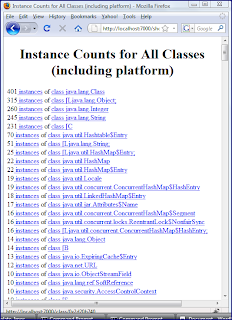
A significant aid in understanding what these web pages generated by
So far, I have looked at using
One method for generating a heap dump in Visual VM is to simply right click on the desired process and select "Heap Dump". This method is shown in the next screen snapshot.

This generates the heap dump as indicated by its name underneath the Java process.

A second approach for generating a heap dump with VisualVM is to click on the Java process of interest so that relevant tabs ("Overview", "Monitor", "Threads", and "Profiler") come up in VisualVM. Selecting the "Monitor" tab provides the "Heap Dump" button as shown in the next screen snapshot.

Clicking on the "Heap Dump" button leads to a heap dump being generated just as it was with the right click option described above. This is shown in the next screen snapshot, which happens in this case to show the "Summary" tab of the analyzed heap dump.

In addition to the "Summary" tab of the heap dump analysis, other interesting details from the heap dump are presented in the "Class" tab. This tab includes horizontal bar charts that graphically indicate the percentage of total instances that are associated with each class. An example is shown in the next screen snapshot.

The displayed classes are spelled out rather than using symbols like those described above for

Conclusion
VisualVM provides several advantages when creating and analyzing heap dumps. First, everything from creation to analysis is in one place. Second, the data is provided in what may be considered a more presentable format with graphical support. Finally, other tools can also be used in VisualVM in conjunction with the heap dump analysis. VisualVM provides one-stop shopping for many of the development, debugging, and performance analysis needs of the Java developer.
Additional References
⇒ Troubleshooting Java SE
⇒ Troubleshooting Guide for Java SE 6 with HotSpot JVM (PDF)
⇒ Java SE 6 Performance White Paper
⇒ What's in My Java Heap?
⇒ Analyzing Java Heaps with jmap and jhat
⇒ Java Memory Profiling with jmap and jhat
The jmap (Java Memory Map) tool is one of several ways that a Java heap dump can be generated. The Java Heap Analysis Tool (jhat) TechNotes/man page lists four methods for generating a heap dump that can be analyzed by jhat. The four listed methods for generating a heap dump are the use of
jmap, JConsole (Java Monitoring and Management Console), HPROF, and when an OutOfMemoryError occurs when the -XX:+HeapDumpOnOutOfMemoryError VM option has been specified. A fifth approach that is not listed, but is easy to use, is Java VisualVM. (By the way, another method is use of the MXBean called HotSpotDiagnosticMXBean and its dumpHeap(String,Boolean) method.)The
jmap tool is simple to use from the command line to produce a heap dump. It can be used against a running Java process whose piocess ID (pid) is known (available via jps) or against a core file. In this post, I'll focus on using jmap with a running process's ID.The jmap page states that
jmap is an experimental tool with relatively limited capabilities on Windows that may not be available with future versions of the JDK. This page also lists options available to specify how jmap should generate a heap dump.The following screen snapshot shows how
jmap can be used to dump a heap.
The generated dump file,
dustin.bin in this case, is binary as shown in the next screen snapshot.
The binary heap dump can be read with the
jhat tool. Sun's Java SE 6 included implementation of jhat replaces HAT, which was formerly available as a separate download. It is almost trivial to run jhat. One need only invoke jhat on the heap dump file generated with jmap (or alternative dump generation technique) as shown in the next screen snapshot.
With the heap dump generated (
jmap) and the jhat tool invoked, the dump can be analyzed with a web browser. The output on the console tells us that the dump is available on port 7000 (this default port can be overridden with the -port option). When I run the browser on the same machine on which I ran jhat, I can use localhost for the host portion of the URL. The starting page using localhost and port 7000 is shown in the next screen snapshot.
Arbitrary Object Query Language (OQL) statements can be written to find necessary details in the heap dump. The
jhat-started web server includes OQL help at the URL http://localhost:7000/oqlhelp/. See also Querying Java Heap with OQL for more details on how to use OQL. However, one can often find what one needs simply using the already provided information and moving between pieces of information using the provided hyperlinks.The following screen snapshot demonstrates one of the more useful pages available thanks to
jhat's web server-based output of the heap dump. This page shows the number of instances of various Java objects, including platform objects.
A significant aid in understanding what these web pages generated by
jhat mean is the VM Specification on Class File Format. In Section 4.3.2 ("Field Descriptors") of this document, there is a table that shows the mapping of field descriptor characters to the data type we use. According to this table, "B" indicates a byte, "C" indicates a char, "D" indicates a double, "F" indicates a float, "I" indicates an integer, "J" indicates a long, "L<someClassName>" indicates a reference (instance of a class), "Z" indicates a boolean, and [ indicates an array.So far, I have looked at using
jmap and jhat from the command-line to generate a heap dump and provide a web browser-based method for analyzing the generated heap dump. Although these tools are relatively easy to use, VisualVM provides similar functionality in an even easier approach.One method for generating a heap dump in Visual VM is to simply right click on the desired process and select "Heap Dump". This method is shown in the next screen snapshot.

This generates the heap dump as indicated by its name underneath the Java process.

A second approach for generating a heap dump with VisualVM is to click on the Java process of interest so that relevant tabs ("Overview", "Monitor", "Threads", and "Profiler") come up in VisualVM. Selecting the "Monitor" tab provides the "Heap Dump" button as shown in the next screen snapshot.

Clicking on the "Heap Dump" button leads to a heap dump being generated just as it was with the right click option described above. This is shown in the next screen snapshot, which happens in this case to show the "Summary" tab of the analyzed heap dump.

In addition to the "Summary" tab of the heap dump analysis, other interesting details from the heap dump are presented in the "Class" tab. This tab includes horizontal bar charts that graphically indicate the percentage of total instances that are associated with each class. An example is shown in the next screen snapshot.

The displayed classes are spelled out rather than using symbols like those described above for
jhat-based heap dump analysis. One can right-click on any class in the "Classes" tab and select "Show in Instances View" to see details on each individual instance of the selected class. This is shown in the next screen snapshot.
Conclusion
VisualVM provides several advantages when creating and analyzing heap dumps. First, everything from creation to analysis is in one place. Second, the data is provided in what may be considered a more presentable format with graphical support. Finally, other tools can also be used in VisualVM in conjunction with the heap dump analysis. VisualVM provides one-stop shopping for many of the development, debugging, and performance analysis needs of the Java developer.
Additional References
⇒ Troubleshooting Java SE
⇒ Troubleshooting Guide for Java SE 6 with HotSpot JVM (PDF)
⇒ Java SE 6 Performance White Paper
⇒ What's in My Java Heap?
⇒ Analyzing Java Heaps with jmap and jhat
⇒ Java Memory Profiling with jmap and jhat
Thứ Ba, 23 tháng 6, 2009
JMX 2 Postponed Until Java SE 8
It was disappointing, but not altogether surprising, to learn that JMX 2 will not be part of Java SE 7. Anyone who saw my Colorado Software Summit 2008 presentation JMX Circa 2008 is aware of how excited I was for some of the new features that were tentatively planned for Java SE 7. Java Management Extensions (JMX) is already a highly useful technology, but the advancements in JMX hoped for in Java SE 7 are convenient and welcome. With the long period of time between Java SE 6 and Java SE 7, it likely means quite a wait for JMX 2 features that are now expected with Java SE 8.
Đăng ký:
Bài đăng (Atom)